You Weren't Invited — Until You Were: The Secret Dinner Circuit That's Rewriting How America Eats
You Weren't Invited — Until You Were: The Secret Dinner Circuit That's Rewriting How America Eats
The address came in a text at 4 p.m. Before that, all anyone had was a neighborhood and a start time. You bring cash, you bring nothing else, and you definitely don't post the location until at least three days after you've left. Those are the rules. Nobody wrote them down anywhere, but everyone at the table already knows them.
This is underground dining, American style — and it's a lot more alive than most people realize.
A Table With No Front Door
Across the country, a loose and largely invisible network of rogue chefs, passionate home cooks, and flat-out food obsessives have been hosting invitation-only dinners for years. The venues range from Brooklyn lofts and Los Angeles backyards to converted barns in rural Ohio and basement apartments in Chicago that smell like braised short rib before you even hit the bottom step. What they share isn't a cuisine or a price point — it's a deliberate refusal to exist on any platform that could turn them into a reservation widget.
There's no Yelp page. There's no website with a booking calendar. There's definitely no Instagram grid with moody overhead shots of amuse-bouches. The whole operation runs on trust, word of mouth, and the kind of social currency that can't be bought with a credit card.
"The second you make it easy to find, it becomes something else," says one host — we'll call her Dara — who has been running a monthly dinner series out of her Detroit home for four years. She cooks for twelve people at a time, charges a sliding-scale donation, and sources most of her ingredients from two farmers she's known since before she ever thought about hosting. "Once you put it on the internet, you're not running a dinner anymore. You're running a content moment. That's not what this is."
How You Actually Get In
The entry mechanics vary, but the general shape is consistent: someone who has already attended vouches for you. They pass your name to the host, the host decides whether to extend an invitation, and if you're in, you get a message — sometimes weeks later, sometimes the same afternoon — with a date, a time, and whatever other details the host feels like sharing.
Some operations run on a formal vouching system with clear rules about how many new guests a regular can introduce per season. Others are more intuitive, relying on the host's read of whether someone fits the vibe. A few have waiting lists that stretch months out. Almost none of them advertise, and the ones that do keep it cryptic — a single image, a date, nothing else.
In cities like New York, San Francisco, and New Orleans, there are semi-open secrets: certain chefs known to host quarterly, certain addresses that circulate in specific creative communities. In smaller cities, the network is tighter and more protective. Miss an invitation without a good reason and you might not get another one for a while.
"It's not gatekeeping for the sake of gatekeeping," says Marcus, who hosts a quarterly dinner in Nashville for around twenty guests. "It's about preserving something. The moment it gets too big or too public, the energy shifts. People start performing instead of eating. I've seen it happen to other dinners. I'm not letting it happen to mine."
The Food Is the Point, But It's Not the Only Point
What gets served at these dinners runs the full spectrum. Some hosts are formally trained chefs who left the industry and found more freedom cooking without a ticket system breathing down their neck. Others are self-taught obsessives who spent years developing a specific cuisine — regional Mexican, West African, pre-war Appalachian, hyper-seasonal fermentation-forward stuff — that doesn't have a natural home in mainstream restaurant culture.
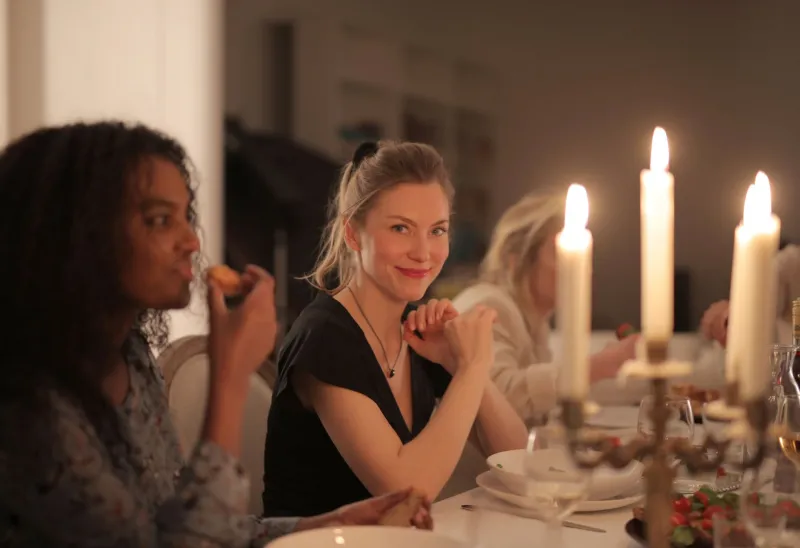
The meals are often long. Multiple courses, unhurried pacing, wine or cocktails that someone brought or the host sourced specifically for the evening. There's usually a communal element — dishes passed family-style, or a moment where everyone's eating the same thing at the same time and the room gets quiet in that specific way that only happens when food is genuinely good.
Dara describes one recent dinner where she served a single heritage grain porridge as the fourth course — nothing on it but a little fat and salt — and the table went completely silent. "That's what I'm chasing," she says. "You can't manufacture that. It only happens when people are actually present."
The absence of phones — or at least the strong social discouragement of them — plays a role. Without the reflex to document everything, people tend to actually eat. And talk. Strangers who arrived knowing nobody often leave with each other's numbers.
The Legal Gray Area Nobody Really Talks About
It would be dishonest to skip this part. Underground supper clubs occupy a complicated legal space. In most states, charging money for food prepared in a non-commercial kitchen without proper licensing and health inspection is technically not permitted. Most hosts are aware of this and navigate it in various ways — framing payments as donations, operating on a gifting model, or simply keeping the scale small enough that formal scrutiny is unlikely.
The health department conversation is one that experienced hosts tend to find a little exhausting. "I've worked in licensed kitchens," Marcus says. "I know what actually goes on. My home kitchen is cleaner than most of them. The inspection theater is about liability, not safety." It's a perspective you'll hear often in this world — not naive exactly, but grounded in a genuine frustration with regulations that weren't designed with this kind of cooking in mind.
Most underground dinners that have run into trouble did so because they got too visible, too fast. The ones that have survived years, even decades, tend to be quietly consistent — same rough size, same community, same low-key approach to publicity.
Why the Secrecy Is Actually the Meal
Ask anyone who's been to one of these dinners what made it memorable, and the food almost always comes up second. What comes up first is the feeling of being somewhere that wasn't supposed to exist — a room full of people who all found their way there through some invisible thread of mutual trust.
There's a particular kind of intimacy that comes from sitting down to eat in a place with no brand identity, no Yelp average, no chef's-table marketing copy. You're just there. The cook is right in front of you. The people next to you are strangers who someone, somewhere, decided were worth inviting.
Dara puts it plainly: "Restaurants are designed to make you feel like a customer. This is designed to make you feel like a guest. Those are not the same thing."
The underground supper club circuit isn't trying to disrupt the food industry. It's not a movement with a manifesto or a funding round. It's just a bunch of people who love to cook, found a way to do it on their own terms, and kept it close enough to their chests that it stayed real.
If you want in, you probably already know someone who knows someone. Start there.