Ink and Invention: The Secret World of People Drawing Countries That Have Never Existed
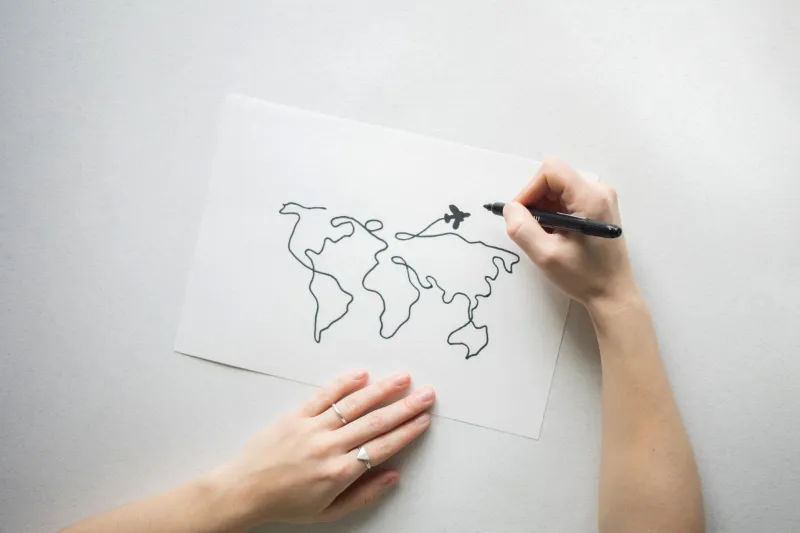
Somewhere in a spare bedroom in Tucson, a retired schoolteacher is carefully inking the coastline of a continent that will never appear on any globe. She's been at it for six years. The rivers drain correctly. The trade winds make sense. And she can tell you exactly why the northern empire collapsed four hundred years ago — give or take a decade.
This is the world of fictional cartography — and it is far stranger, far more rigorous, and far more populated than you'd expect.
More Than Doodling a Dragon Map
When most people picture a hand-drawn fantasy map, they think of Tolkien's Middle-earth, maybe a Dungeons & Dragons campaign notebook, something with a compass rose and a sea monster in the corner. What's happening in this community goes considerably further than that.
The people building these worlds — scattered across the US in basements, dining rooms, and rented studio spaces — aren't illustrators waiting for a book deal. Many of them have no plans to publish anything. They're building places for the sake of the building itself. The map is the destination, not a tool to get somewhere else.
"I've had people ask me what the story is," says one hobbyist cartographer from Portland who goes by Vellan in online spaces and asked that we not use his legal name. "There isn't one. The map is the thing. I'm not writing a novel. I'm making a world."
Vellan's current project — which he's been working on for three years — covers a landmass roughly analogous in size to Southeast Asia. He can describe the prevailing monsoon patterns, the distribution of iron deposits, and the rough population density of each region based on the agricultural viability of the terrain. He has hand-lettered place names in two invented writing systems. He's documented approximately forty words of a language spoken only in the archipelago on the map's southwestern edge — a language that died out in his world's internal history about six centuries before his map's "present day."
None of this will ever be read by anyone outside a small circle of people who understand why this matters.
The Convention Circuit Nobody Talks About
Twice a year, small regional gatherings pull these cartographers together. They're not flashy. No celebrity guests, no merchandise tables, no lines around the block. A church fellowship hall in Columbus. A library meeting room in Albuquerque. A rented space above a bar in Minneapolis. Attendance tends to run between twenty and sixty people, and word of the next event travels almost entirely by word of mouth or through a handful of forums that look like they were designed in 2009 — because they were.
What happens at these meetups is essentially peer review. People spread their maps out on folding tables and invite scrutiny. The conversations get technical fast. Does your river system make hydrological sense? If this mountain range runs east-west, why isn't there a rain shadow on the northern face? Your capital city is landlocked and your trade economy depends on maritime routes — how does that work, exactly?
It's the kind of rigor you'd expect at an academic conference, applied to something that doesn't exist.
"The internal logic has to hold," explains a woman from Atlanta who's been attending these gatherings for four years and makes her maps using a combination of dip pen and watercolor. "If your world doesn't make sense on its own terms, it falls apart. You can feel it when something's wrong, even if you can't immediately say what."
She recently spent six weeks reworking the western coastline of her primary continent after another attendee pointed out that her prevailing ocean currents would make the climate of her northern cities implausible. She didn't resent the note. She went home and fixed it.
Why Analog, Why Now
Here's the thing that hangs over every conversation in this community without anyone quite saying it directly: AI can generate a passable fantasy map in about forty-five seconds.
Everyone knows this. And almost no one in these rooms cares, except in the sense that it clarifies something for them about why they do what they do.
"When I put ink on paper, I'm making a decision," Vellan says. "Every line is a choice I have to live with. If I mess up a river valley, I have to figure out how to work with it or start that section over. There's no undo. There's no generate-again."
That friction — the irreversibility of ink, the physical accumulation of hours — seems to be part of the point. These maps accrete meaning through the labor of making them. The watercolor wash that took four attempts to get right carries something that a rendered image doesn't, at least not for the person who made it.
There's also something about the specificity of the hand. AI-generated maps tend toward a certain kind of plausibility, a smoothed-out competence that reads as generic once you've seen enough of them. The maps at these gatherings look particular. Idiosyncratic. You can see the maker's hand in them, literally — the slight tremor in a long coastline, the way one cartographer always clusters her mountain ranges tighter than geography strictly requires, the ornate borders another guy has been refining across every map he's made for a decade.
What It's Actually About
Ask these cartographers why they do this and the answers eventually converge on something that's hard to articulate without sounding grandiose. Control is part of it — the appeal of a world that behaves according to rules you set and that doesn't surprise you with anything you didn't build in. Escape is part of it, though most of them bristle a little at that framing, because escape implies running away from something, and they'd rather describe it as running toward.
But the answer that comes up most often, in different words, is something like: this is what it feels like to pay attention.
In a world that rewards speed and volume and the appearance of productivity, spending two hundred hours on a coastline that no one will ever sail is a fairly radical act. It insists that some things are worth doing slowly. That detail matters even when no one's checking. That a place can be real — genuinely, structurally real — even if it only exists in one person's head and on a piece of paper rolled up in a cardboard tube in a closet in Tucson.
The retired schoolteacher's continent doesn't have a name yet. She's been trying to figure out what the people who live there would call it — not the name outsiders gave it, but the name they use for themselves, the one that translates to something like the place where we are.
She figures she'll know it when she hears it.