Hello, Central: The Tiny Exchanges Still Routing America's Calls by Hand
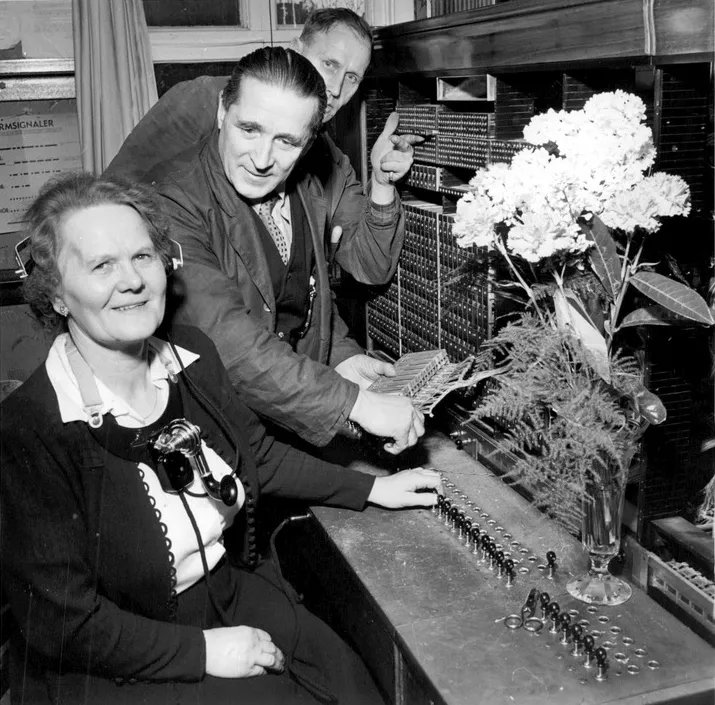
Photo: Unknown photographer, Public domain, via Wikimedia Commons
Somewhere in a low-slung cinder block building off a county road in the rural Midwest, a woman named Darlene sits in front of a panel that looks like it belongs in a 1940s newsreel. Rows of jacks. A headset. A cord board. She picks up, says "Number please," and connects a farmer to his veterinarian in about four seconds flat. No app. No algorithm. No fiber optic backbone humming somewhere in a data center in Virginia.
Just Darlene, and a machine that the phone company stopped making parts for in 1974.
This is not a novelty. It's Tuesday.
A System That Never Got the Memo
When the telecommunications industry lurched toward digital switching in the late 1970s and early 1980s, most of the country came along for the ride. Rural cooperatives and independent telephone companies — the small outfits that had been wiring farm country since the 1930s — faced a choice: upgrade to digital central office equipment, or figure out something else. Most upgraded. A few didn't.
The reasons varied. Some communities couldn't afford the transition. Some had equipment in such good working order that replacing it felt like throwing away a perfectly functional tractor because a newer model existed. And some, frankly, just didn't want to. The analog infrastructure worked. The people who maintained it knew it inside and out. Why fix what wasn't broken?
Decades later, a small but stubborn collection of these exchanges are still operating — serving communities where the word "broadband" is still something of a punchline, and where the telephone is not a smart device but a dumb one, in the best possible sense.
The Knowledge Problem
Here's the thing nobody talks about when they discuss analog telephone infrastructure: the equipment itself isn't the hard part. The hard part is the knowledge required to keep it running.
Step-by-step Strowger switches — the mechanical selectors that route calls in these older exchanges — are precision instruments. They require regular cleaning, careful adjustment, and an intuitive feel for when something is slightly off. The technicians who trained on this equipment learned their craft in a world where the phone company ran formal schools for it. Those schools closed. The textbooks are out of print. The institutional memory lives almost entirely in the heads of people who are, to put it gently, not getting any younger.
Dave, a retired independent telephone company technician in his late sixties, spent four decades maintaining step equipment across three counties in Appalachia. He describes the work like a doctor describing a patient he's known for years. "You learn its sounds," he says. "A healthy exchange has a rhythm to it. When something's wrong, you hear it before you see it. That's not something you can put in a manual."
Dave has been trying to document what he knows for the better part of a decade. He's filled several three-ring binders. He's not sure it's enough.
Who's Still Out There
The surviving analog exchanges aren't easy to find, and their operators aren't exactly issuing press releases. Some serve genuinely remote communities — mountain hollows, island clusters, desert outposts — where the cost of running fiber to every household remains prohibitive. Others persist in small towns where the local telephone cooperative made a deliberate choice to maintain their existing infrastructure rather than take on debt to replace it.
What they share is a relationship between their equipment and their community that's hard to quantify. The switchboard operator knows who's calling whom. She knows when a line that's usually active goes quiet for too long. She notices things. In communities where social infrastructure is thin and people live far apart, that noticing matters.
This isn't nostalgia talking. It's function.
The Parts Problem
If the knowledge problem is serious, the parts problem is existential. When a component fails in a digital switching system, you order a replacement. When a component fails in a 1950s-era step-by-step exchange, you call around to other people who are running the same equipment, or you find a retired technician who might have a spare in his garage, or you machine the part yourself if you have the skills and the raw stock.
A small but dedicated network of analog telephone enthusiasts — some of them former industry professionals, some of them hobbyists who got deep into telephone history — has quietly become a parts supply chain for these surviving exchanges. Retired equipment gets stripped for components. Warehouses of obsolete telephone gear get inventoried and catalogued. Someone in Ohio ships a relay assembly to someone in rural Montana and a community's phone service continues for another few years.
It's an informal system held together by relationships and shared obsession. Exactly the kind of thing that's invisible until it stops working.
What Happens Next
The Federal Communications Commission has been pushing for the eventual retirement of legacy copper telephone infrastructure for years, and the regulatory pressure on small independent carriers is real. At the same time, the communities served by these systems often have limited alternatives. Cellular coverage in genuinely rural areas remains spotty. Satellite internet services are improving but not universal. For some households, the landline — the old, mechanical, analog landline — is still the most reliable communication link they have.
There's an argument, not often made loudly enough, that these surviving exchanges represent something worth preserving not just as historical curiosities but as functional resilience. A mechanical switching system doesn't go down when a software update corrupts a server. It doesn't require a cybersecurity patch. It works during a power outage if you have a generator, and it works the same way it worked forty years ago, which means the person who learned to fix it forty years ago can still fix it today.
Darlene, back at her cord board, would probably just shrug at all of this. She's got calls to route.
"People around here like knowing there's a person on the line," she says. "They like that I know their voice. I don't think that's a small thing."
Neither do we.