Last Transmissions: The Ham Radio Archaeologists Catching History Before It Goes Silent
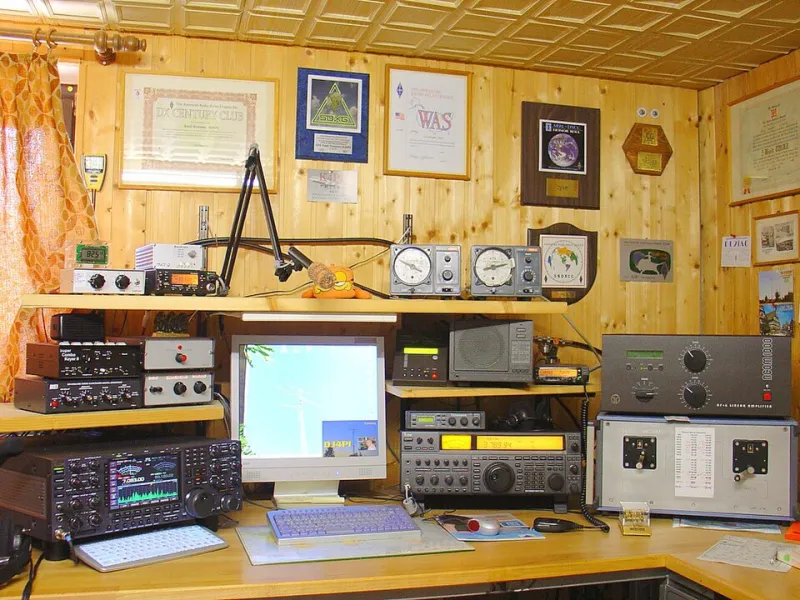
Photo: Emil Neuerer, DJ4PI, CC BY-SA 3.0, via Wikimedia Commons
It comes in at 3:40 in the morning, Central time. A voice — male, unhurried, slightly distorted by distance and equipment age — reads a weather report for a stretch of agricultural county in the Missouri River valley that hasn't had a dedicated broadcast service in eleven years. Except it does have one. Just not one anyone officially knows about anymore.
The man recording this from a converted garden shed in suburban Omaha has been awake since two. He's been awake since two a lot of nights. His logbook for the past eighteen months runs to nearly four hundred pages. His hard drives hold recordings that nobody asked him to make, of broadcasts that nobody officially acknowledges still exist, transmitted from equipment that in some cases predates the operator's grandchildren.
He is, by his own description, an archaeologist. The site just happens to be the electromagnetic spectrum.
The Infrastructure Nobody Talks About
American radio infrastructure is in a state of ongoing, uneven collapse. Commercial FM and AM stations have been consolidating and shutting down for two decades, a process that accelerated hard during the pandemic years and hasn't reversed. The emergency broadcast networks that were built during the Cold War and retrofitted several times since are aging faster than they're being replaced. Repeater networks — the relay systems that allow ham radio signals to travel long distances — are maintained by volunteer clubs that are themselves aging and shrinking.
None of this is secret. It's just not something most people think about, because most people don't need to. Cell phones work. The internet works. The invisible lattice of analog radio infrastructure that was built up over a century of American life is becoming background noise in both the literal and figurative sense.
But signals are still traveling through it. Some of them are official. Some of them are technically legal but operating in a regulatory gray zone. Some of them are genuinely mysterious — automated systems that have been running on timers since someone set them up and walked away, broadcasting into a void that may or may not have anyone listening.
The people documenting all of this are mostly licensed amateur radio operators, though the community includes some unlicensed listeners who operate receive-only setups and stay carefully on the right side of federal regulations about what you can and can't record. They communicate through mailing lists, private forums, and at regional hamfests — the trade shows and meetups that form the social backbone of amateur radio culture — where conversations about unusual signals and obscure networks happen in the parking lot as much as in the scheduled sessions.
What Gets Recorded
The range of what this community documents is wider than you might expect.
At one end are the straightforward historical preservation projects: final transmissions from commercial stations that have since gone dark, captured in real time by operators who knew the end was coming and pointed their equipment at the frequency and hit record. These have a particular emotional weight. A sign-off is a ritual — there's usually music, sometimes a statement from the owner or the last on-air personality, sometimes just a tone and then static — and the people who capture them treat the recordings with corresponding care.
Then there are the emergency networks. The US has a patchwork of radio systems designed for disaster communication: FEMA infrastructure, state emergency management networks, county-level systems that were built to different specs at different times and have never been fully integrated. Documenting these is partly about understanding what still works and partly about creating a record of what existed before it's decommissioned. Some operators have formal relationships with emergency management agencies. More are working independently, driven by a conviction that someone should know what's out there.
The genuinely strange category is the automated broadcasts — signals that appear to be running without active human involvement, often on frequencies that haven't been officially assigned in years. Some of these have mundane explanations: a timer-controlled system for a business that closed, an agricultural sensor network that outlasted the farm operation it was built for. Others resist easy explanation. The community has a healthy mix of rigorous skeptics and people who are comfortable sitting with ambiguity, which makes the culture around these signals interesting.
The Equipment Question
Documenting dying radio infrastructure requires radio equipment, and the irony is not lost on anyone that the gear best suited for this work is itself often vintage.
Software-defined radio — SDR, in the shorthand — has democratized a lot of what used to require expensive dedicated hardware. A decent SDR setup can run under a hundred dollars and will let you monitor a wide swath of the spectrum simultaneously, which is useful when you're trying to catch signals that appear unpredictably. But serious operators tend to have hybrid setups: SDR for scanning and monitoring, older analog receivers for certain frequencies where they perform better, and a collection of antennas that would look alarming to any HOA in the country.
The logging and cataloging work is where individual approaches diverge most sharply. Some operators maintain meticulous databases with timestamps, frequencies, signal strengths, and transcriptions. Others work more intuitively, keeping recordings organized by date and trusting their memory for context. A few have built custom software to help with the cataloging, which they share freely within the community.
The Reason Behind the Ritual
Ask the people doing this work why they do it and you get answers that range from the technical to the philosophical.
The technical answer is that radio history is underpreserved. The Library of Congress has significant audio archives, and there are academic projects focused on broadcast history, but they tend to cover the mainstream: major network programming, landmark news broadcasts, historically significant transmissions. The texture of everyday American radio — the local weather readers, the agricultural extension broadcasts, the small-town AM stations that were the soundtrack of entire communities for fifty years — is mostly gone, and what isn't gone yet is going.
The philosophical answer cuts a little deeper. These operators have spent years, in some cases decades, developing a relationship with the electromagnetic spectrum that most people don't have. They understand it as a shared resource, a commons that has been shaped by human decisions and can be reshaped by them. Watching infrastructure decay without anyone marking its passage feels, to them, like a specific kind of carelessness — the kind that happens when a society decides that what's new is what matters and everything else can quietly disappear.
So they stay up until 3:40 in the morning. They fill logbooks. They maintain hard drives. They catch the voices that are still traveling through the air, for no audience, on equipment that's older than most of the people they know, because someone decided these voices were worth the trouble of keeping.
The static between transmissions is getting longer. They're paying attention.