Thirty Years in the Judge's Chair: The Talent Shows That Never Wanted to Be Famous

Photo: Trish Steel, CC BY-SA 2.0, via Wikimedia Commons
There's a moment at every small-town talent show that would never survive contact with a television producer. It usually happens around the third act, when somebody's grandmother shuffles onto a plywood stage with an accordion nearly as old as she is, and the audience — maybe sixty people, most of them related to somebody else in the room — goes quiet in a way that no arena crowd ever does.
Nobody films it. Nobody clips it. Nobody wants to.
The Longest-Serving Judge in Cass County
Dorothy Fetters has judged the same talent show at the same county fair for thirty-one years. She has a laminated scorecard she made herself in 1994 and a pencil she refuses to replace. When asked what she's looking for, she doesn't hesitate.
"Effort that costs something," she says. "You can tell when a kid practiced till their fingers hurt. You can't fake that. You also can't auto-tune it, which I consider a feature."
Dorothy has never once seen a performance go viral, and she'd be suspicious of one that did. Her scoring rubric rewards stage presence, yes, but also what she calls "nerve" — the willingness to get up in front of neighbors who will see you at the hardware store on Monday. That's a higher-stakes audience than any panel of celebrity judges, if you think about it. Simon Cowell doesn't run into you at the pharmacy.
A Trophy You Could Drop on Your Foot
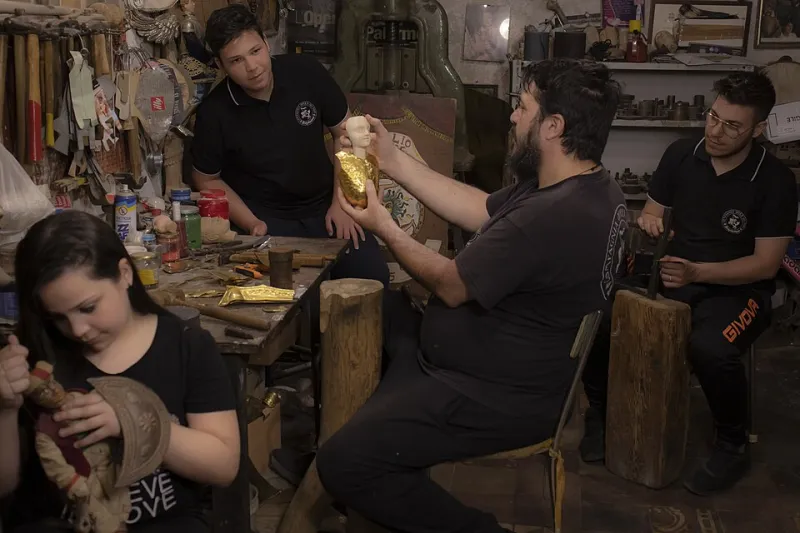
Backstage — which is to say, behind a curtain of painted bedsheets — the prizes sit on a folding table. They are not ordered from a catalog. They're cast by hand by a retired machinist named Gene, who pours and polishes each award in a shop behind his house and engraves them on a lathe older than most of the contestants.
"A trophy should weigh something," Gene says. "If a ten-year-old can't barely lift it, that's about right."
He's not wrong. There's a difference between a participation medal that arrives in a bubble mailer and a chunk of cast metal with your name scratched into it by a man who watched you sing. One goes in a drawer. The other goes on the mantel and stays there for forty years, and becomes the thing your grandkids ask about.
The Accordionist Who Outlived Every Trend
The undisputed star of this particular circuit is Walt, 84, who has played the same polka medley at the same fall show since roughly the Nixon administration. He was there before talent shows were televised, and he'll be there after whatever replaces them finishes replacing them.
Walt has no interest in a bigger stage. "Who would I be playing for? Strangers?" he asks, genuinely puzzled. "I know everybody here. I know who needs the fast song and who needs the slow one."
That sentence contains more audience intelligence than most streaming platforms have managed to accumulate.
Why Nobody Here Is Competing for Your Attention
The argument for these shows isn't nostalgia, exactly. It's that they operate on a completely different economy than the attention economy. Nothing is monetized. Nothing is optimized. There is no algorithm to please because there is no algorithm — just Dorothy, her laminated scorecard, and a room full of people who came because someone told them to come.
The performances are uneven. Some acts are genuinely rough. A middle schooler's magic trick collapses midway through and the crowd cheers harder for the recovery than they would have for the trick. Try finding that on a platform that rewards only the polished and the outrageous.
The Most Honest Stage in America
There's a case to be made — and this is that case — that the community center talent show is the last performance venue in the country with nothing to sell you. No ticket tiers, no merch table, no content strategy. Just a plywood stage, a hand-poured trophy, and an accordionist who knows your name.
The velvet rope, as it turns out, was never the point. The bingo chips on the judge's table were.