The Wobbly Arrow: A Defense of the Last Honest Advertisement
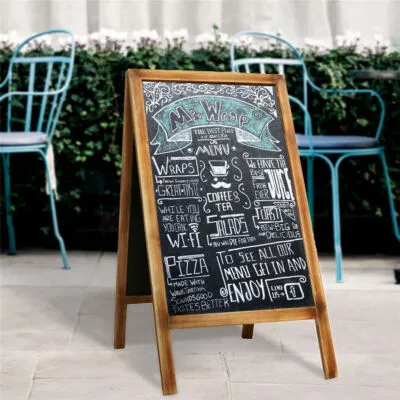
Photo: chalkboard sandwich board sidewalk sign cafe hand lettered, via i.ebayimg.com
Let me say the quiet part loud: a hand-chalked sandwich board is the last advertising format in America that a human being can look at without being tracked, targeted, or retargeted. And there are people — real ones, with chalk on their knuckles — fighting to keep it that way.
A Day on the Chalk Circuit
Mara does eleven stops on a Tuesday. She's a freelance chalk artist in a mid-sized city you've driven through, and her route is a small economy unto itself: a taqueria, a coffee shop, a plant store, a barbershop, a bookstore that pays in store credit and coffee, which she accepts because the owner once talked a landlord out of tripling her rent.
Each sign is different because each client is different. The taqueria wants the taco special big and legible from across four lanes of traffic. The plant store wants something that looks like it grew there. The barbershop wants a joke. Mara adjusts her lettering, her color palette, her whole visual instinct, per block.
"A printed sign says 'open,'" she tells me, crouched over the sidewalk with a piece of chalk worn down to a nub. "A hand-drawn sign says someone is here. That's the whole product."
The Badge of Resistance
Talk to independent shop owners and a pattern emerges fast. The hand-lettered sign isn't a budget decision — Mara's rates, multiplied across eleven clients, would cover a printed A-frame that lasts years. It's a statement.
The logic goes like this: corporate chains have infinite signage budgets, brand guidelines, and A/B-tested messaging. They can and do out-spend everyone. What they cannot have is a wobbly arrow drawn by an actual person that morning, advertising soup that an actual person actually made. The imperfection is the brand. The slight lean to the left in the letter R is a certificate of authenticity no printer can replicate.
One bookstore owner put it more bluntly: "When I see a laminated corporate sign, I know exactly what I'm getting. When I see chalk, I know somebody cares today."
Yes, This Is a Labor Story Too
It's also worth naming what this work actually is: skilled, physical, and almost entirely invisible. Chalk artists work in heat, rain threats, and wind, and their product erases itself on schedule. There's no portfolio of finished work — only photographs of finished work, which is a strange way to build a career.
And there's a quieter tension underneath it. As chains roll out digital sidewalk displays — screens that cycle ads and can be updated from a corporate office — the hand-chalked board becomes a labor question as much as an aesthetic one. A screen replaces a person. A chalkboard is a person. Every shop that chooses chalk is choosing to keep someone like Mara on the route.
In Defense of the Wobble
The case for hand-chalked advertising is, ultimately, a case about honesty. It's ephemeral, so it can't be a lie for long. It's local, so it can't be scaled. It's made by a hand you could theoretically shake. When the taqueria's sign says the birria special is back, and you walk in and the birria special is back, an entire honest transaction has occurred — no pixels, no cookies, no funnel.
The wobbly arrow will wash away in the next storm. That was always the deal, and honestly, it's the most trustworthy thing about it.