Signals in the Static: Meet the Americans Listening for Voices That Were Never Meant to Be Heard
3 AM and the Radio Is Talking
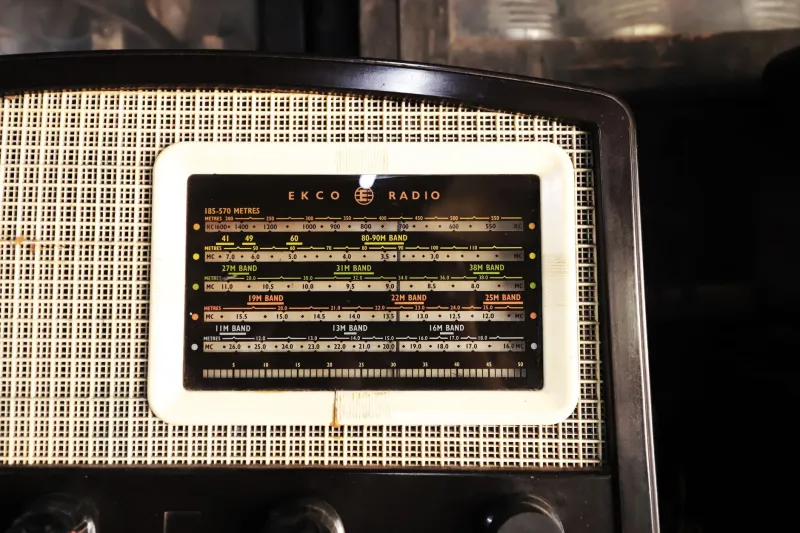
It's past midnight somewhere in suburban Ohio. A guy named Marcus — late forties, works in IT during the day — is sitting in his garage with a shortwave radio, a legal pad, and a thermos of coffee that stopped being hot an hour ago. He's scanning. Not for anything in particular, exactly. More like waiting to see what the night decides to offer.
Then, somewhere around 6925 kHz, he hears it. A tone. A pause. Then a voice — flat, synthetic, almost bored — reading numbers.
Four. Seven. One. Two. Nine. Four. Seven. One. Two. Nine.
He writes it down. He always writes it down.
Marcus is what the shortwave community calls a number station hunter, and he's part of a loose, passionate, slightly obsessive subculture that spends its nights chasing one of the stranger ongoing mysteries in modern communications: broadcasts that have no official source, no confirmed purpose, and no intended public audience — and yet keep showing up, decade after decade, on frequencies anyone with the right equipment can reach.
What Is a Number Station, Exactly?
The short version: number stations are shortwave radio broadcasts consisting of someone — or something — reading sequences of numbers, letters, or phonetic codes. They've been documented since at least World War II. During the Cold War, intelligence agencies on both sides are widely believed to have used them to transmit encrypted messages to field agents. The agent would tune in at a scheduled time, write down the sequence, and decode it using a one-time pad — an unbreakable cipher, as long as the pad stays secret.
The elegant part is that the system is completely deniable. Anyone can hear the broadcast. Nobody has to admit to sending it. If a spy is caught with a one-time pad, it's just a piece of paper with numbers on it.
Here's the part that makes people like Marcus stay up past 3 AM: the stations never fully stopped. The Cold War ended. The Soviet Union dissolved. And the number stations kept transmitting.
Some of them changed format. Some went quiet for years and then came back. New ones appeared. Old call signs resurfaced. The Conet Project, a famous archival effort that compiled recordings of number stations across decades, documented transmissions from dozens of countries — many of which officially denied operating them.
Nobody in any government has ever formally acknowledged running a number station. Not once.
The People Who Can't Stop Listening
The community that has built up around this is genuinely eclectic. There are retired engineers who got into shortwave as teenagers and never quit. There are younger listeners who found the hobby through internet rabbit holes — a Reddit thread, a YouTube video of a haunting broadcast, a passing reference in a podcast. There are amateur radio operators who treat number station logging as a kind of side discipline, separate from their licensed hobby.
What they share is a particular tolerance for uncertainty. Number station hunting doesn't resolve. There's no confirmed answer waiting at the end of the research. You log what you hear, compare notes with others in the community, and sit with what you can't know.
"I've been doing this for eleven years and I still don't know who's behind half the stations I've logged," says a listener in Portland who goes by the handle Radiant_Fog on the forums. "That used to bother me. Now it's kind of the whole appeal."
The community organizes itself through a handful of dedicated websites, Discord servers, and older mailing lists that have been running since the early internet. The most active English-language resource, the Priyom.org schedule, maintains a crowdsourced database of known stations, their frequencies, and their transmission schedules. Members log new recordings, flag anomalies, and debate the origins of signals that don't match any known format.
It's collaborative in the way that the best niche hobbies always are — people contributing small pieces to a puzzle that nobody expects to fully solve.
The Paranoia Is the Point
There's an obvious question lurking here: isn't this all a little... conspiratorial? Sitting in a dark garage, writing down numbers that might be spy codes, from broadcasts that governments deny exist?
The hunters tend to meet this question with patience. The existence of number stations isn't a theory — it's documented. The British government acknowledged in 1998 that the famous "Lincolnshire Poacher" station was operated by GCHQ out of Cyprus. The Cuban intelligence service's "HM01" station has been linked to espionage prosecutions in American courts. The signals are real. The mystery is in the details.
What the community is doing, in a sense, is occupying the space between confirmed fact and unconfirmable speculation — and finding it a surprisingly comfortable place to spend time.
"It's not paranoia if the signals are actually there," says Marcus. "I'm not making up the broadcast. I'm just writing down what I hear and trying to understand it. That feels like the opposite of paranoia to me."
There's something almost meditative about that framing. In an information environment where everything is tracked, targeted, and personalized — where your phone knows what you want before you ask — tuning into a signal that's genuinely not meant for you feels like a small act of freedom. You're not the intended audience. You're not a demographic. You're just a person with a radio in a dark garage, listening to something that exists whether you hear it or not.
The Strange Comfort of the Unresolved
Ask enough number station hunters what keeps them coming back and you start to hear a consistent thread. It's not really about cracking codes or exposing spy networks. It's about the act of paying close attention to something that most people walk right past.
Shortwave radio itself is a dying medium by most metrics. Commercial stations have largely abandoned the spectrum. The infrastructure is old. And yet the frequencies are far from empty. Number stations, utility broadcasts, religious programs in a dozen languages, amateur operators bouncing signals off the ionosphere — the shortwave spectrum is a strange, layered archive of human communication that persists mostly because nobody bothered to turn it off.
The hunters are, in a way, its custodians. They're recording what's there before it fades, building an archive of signals that nobody officially sent, for an audience that was never supposed to exist.
Marcus finishes his coffee, writes down one more sequence, and clicks off the radio around 4 AM. Tomorrow he'll upload the recording to the community database. Someone in Germany or Argentina or rural Tennessee will listen, cross-reference it against known patterns, and add a note.
The signal will probably remain unidentified. That's fine. It was there. He heard it. He wrote it down.
For now, that's enough.