Click, Clack, Resist: The Secret World of Competitive Typewriter Fanatics Who Never Went Digital
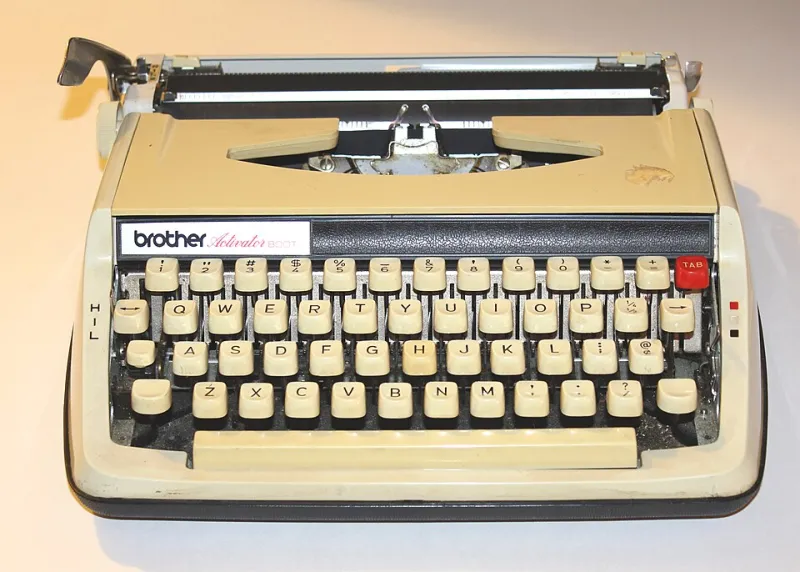
Photo: Dwight Burdette, CC BY 3.0, via Wikimedia Commons
There's a specific sound that stops a room. Not a gunshot, not a fire alarm — a Royal Quiet De Luxe, fully restored, being driven at full speed by someone who's been practicing for eight months. It's a sound that belongs to a different century, and yet here it is, echoing off the cinder block walls of a community center in Columbus, Ohio, while twenty people in folding chairs lean forward like they're watching a horse race.
Welcome to the margins. Welcome to Wiltiky territory.
The Meet Doesn't Have a Name
Nobody here calls it a competition, exactly. The word they use is "session," which carries less ego and more ritual. These gatherings happen in cities across the country — Portland, Nashville, Baltimore, Albuquerque — and they're announced through channels that don't involve social media in any obvious way. A mailing list here, a physical postcard there. Some groups use a Discord server with a name that gives nothing away. You find out through someone who already knows, which is basically how all the good stuff works.
The format varies by chapter, but the bones are consistent. Participants bring their own machines — no borrowing, no sharing, because the whole point is the relationship between typist and typewriter — and they're timed on accuracy and speed across a standardized passage. Judges argue about whether corrective fluid disqualifies a run. They argue a lot, actually. Argument is part of the culture.
"The debate over ribbon ink is genuinely theological," says one regular attendee who asked to be identified only as Marcus, a machinist from outside Pittsburgh. "People have walked out over it."
The Machines Have Personalities
Ask anyone in these circles which typewriter is objectively the best and you'll get an answer delivered with the confidence of someone who has thought about nothing else for three years. Devotees of the Hermes 3000 will cite its Swiss precision and the particular softness of its touch. Olympia SM-series loyalists will tell you about longevity and type consistency. Underwood people are a whole separate thing.
What unites all of them is the conviction that the machine is not interchangeable. You don't just use a typewriter. You learn it. You tune it. You replace the platens, clean the type slugs, adjust the tension, and eventually — if you've done it right — the machine starts to feel like an extension of your nervous system rather than a tool sitting on a desk.
Restoration is its own art form within the subculture. Some people spend months on a single machine, sourcing parts from estate sales, defunct office liquidators, and a surprisingly active international mail-order network. There are repair guides passed around in photocopied packets. There are YouTube channels with subscriber counts in the low thousands that are treated like scripture.
The Surveillance Angle Is Real
It would be easy to write this off as pure nostalgia — people who just like old things, same as the vinyl crowd or the film photography kids. And some of it is exactly that. But there's a harder ideological edge running through parts of the community that's worth taking seriously.
For a significant number of these typists, the machine is a political statement. A typewriter produces no metadata. It doesn't autosave to a cloud server. It doesn't ping a location. It doesn't phone home. What you write on a typewriter exists only on the page in front of you, and the only way anyone reads it is if they physically take that page.
In an era when every keystroke on a connected device is theoretically logged somewhere, that's not nothing. Writers, journalists, researchers, and people who simply want their private thoughts to remain private have started looking at mechanical machines not as antiques but as infrastructure. The typewriter, in this reading, isn't behind the times. It's ahead of them.
"People think we're eccentric," says a woman who runs a small restoration shop out of her home in Tucson. She's been doing this for eleven years and has a three-month waiting list. "We think we're the only ones being rational."
Speed as Ceremony
Back at the session in Columbus, the fastest typist of the night finishes her passage and pulls the sheet free with a practiced flick. There's applause. Someone checks her accuracy against the source text. One transposition error, which the room debates for four minutes before agreeing it doesn't affect her standing.
Her machine is a 1962 Olympia SM4, dark green, with a modified carriage return spring that she adjusted herself. She's been using it for six years. She talks about it the way musicians talk about instruments — with a mix of technical precision and something that sounds a lot like love.
The session wraps up around eleven. People pack their machines into cases and bags. There's a brief, loud argument about whether next month's location should move to avoid a scheduling conflict with something else in the building. Nobody agrees, but everyone agrees to figure it out.
They file out into a parking lot that looks completely ordinary. No sign that anything happened. That's the point.
The frequency is there if you know how to tune in.