Out-of-Town Numbers: Seven Ballparks Where the Scoreboard Has a Pulse
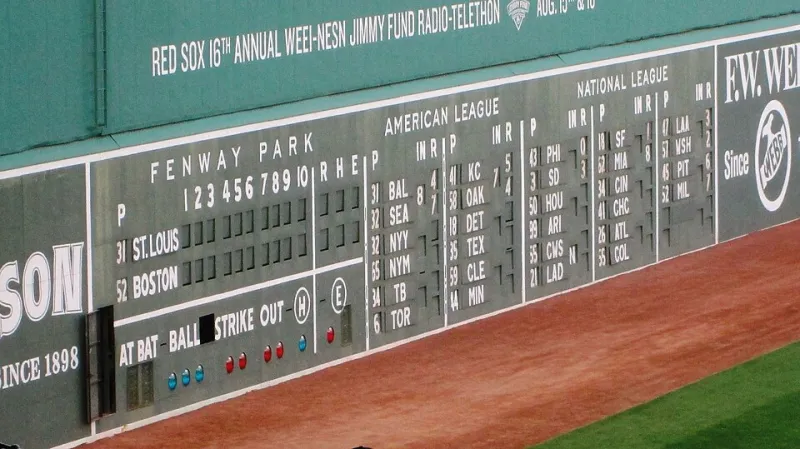
Photo: Beyond My Ken, CC BY-SA 4.0, via Wikimedia Commons
A scoreboard is supposed to be background. You glance at it. You check the inning. You go back to the game. But in a few ballparks and fairgrounds around the country, the scoreboard is a live performance. Someone has to climb a ladder. Someone has to find the right number. Someone has to hang it, flip it, slide it, or crank it while the crowd watches and the players wait. These are the scoreboards that still need a human being, and they are better for it.
1. The Catwalk Above the Third-Base Line
At a Class A ballpark in the Carolina League, the scoreboard is a manual board bolted to the back of the grandstand. The keeper is a retired schoolteacher named Ray, and he reaches it through a narrow catwalk that smells like old wood and popcorn. He has a hook for the inning, a rack of metal numbers, and a small radio tuned to the press box. When the home team scores, Ray hears it first from the crack of the bat and then from the voice in his earpiece. He picks up the number, slides it into the slot, and the crowd behind him cheers a half-second before the rest of the park knows.
Ray does not call himself a scoreboard operator. He calls himself 'the number guy.' He has been doing it since 1998, and he can tell you which numbers stick in humid weather and which ones fall out if you do not seat them right. The board is not a relic to him. It is a machine with moods.
2. The Fairground Horse-Show Board
At a county fairground in central Illinois, the scoreboard is a whiteboard with hooks and a row of laminated numbers. The keeper sits at a folding table under the announcer's booth, wearing a windbreaker and a lanyard. She tracks points for the horse show, writes names on a clipboard, and hangs the totals in a grid. The board is low-tech enough that anyone can read it from the bleachers. It is also easy to fix. When a judge's score gets corrected, she does not need a software update. She needs a dry-erase marker and a steady hand.
The fairground board is not just a scoreboard. It is a public ledger. Families stand in front of it and take photos. Kids run up to check their mother's name. The keeper knows most of them by sight, and she knows which classes run long and which judges are quick with a pen.
3. The High-School Football Flip Chart
On Friday nights in the fall, a high-school field in West Texas uses a scoreboard that is part flip chart, part family heirloom. The board is mounted on a trailer behind the end zone. Two volunteers work it from a stepladder, one on each side. They flip the down indicator, hang the quarter, and slide the score. The lights are bright enough to read the numbers from the parking lot.
The volunteers are usually parents. They wear team colors and carry a thermos. They have a system: one person watches the referee, the other watches the clock. When a touchdown is confirmed, the crowd turns toward the trailer, not the field, for the official word. It is a small piece of theater, and the volunteers know their cue.
4. The Dirt-Track Lap Board
At a short-track speedway in upstate New York, the scoreboard is a lap board with hand-painted numbers and a row of light bulbs. The keeper is a former driver named Marv, and he works from a wooden booth above the grandstand. He flips the lap counter by hand, and he keeps a grease pencil tally of the leaders on a piece of cardboard. The board is not precise. It is honest. When Marv misses a lap, he fixes it before the next caution.
The dirt-track crowd does not mind the imperfection. They are watching the cars, the dust, and the scoreboard in roughly that order. But when Marv flips the final lap, the whole grandstand feels it. A digital board would blink. Marv's board clacks.
5. The Swimming Meet Number Wall
At a high-school natatorium in Ohio, the scoreboard is a wall of numbered cards and a magnetic strip. The keeper sits at a table near the starting blocks with a stopwatch and a clipboard. She writes the lane numbers, the times, and the team totals, then hangs the cards in a row. The wall is not fast. It does not need to be. Between races, there is enough time to update it by hand, and the swimmers can see their times before they leave the deck.
The keeper is usually a parent or a former swimmer. She knows the meet format, the scoring rules, and the difference between a disqualification and a no-show. She also knows that the wall is a gathering place. After the final relay, the teams crowd around it to take pictures. The numbers are not just data. They are the record of the night.
6. The Rodeo Arena Board
At a rodeo arena in Oklahoma, the scoreboard is a large wooden board with painted events and a set of hanging numbers. The keeper works from a platform near the chutes, and he updates the board between events. The board is hitched to a tractor and moved into place before the grand entry. It is not portable in the modern sense. It is portable in the sense that a tractor can pull it.
The keeper is a rodeo parent, a volunteer, or a former contestant. He knows the order of events and the names of the contestants. He also knows that the crowd reads the board like a newspaper. When a score goes up, the arena reacts. When a score is revised, the keeper has to climb back up and change it, and everyone sees him do it.
7. The Little League Hand-Turned Inning Wheel
At a Little League field in central California, the scoreboard is a small wooden box with a hand-turned inning wheel and a set of painted numbers. The keeper is usually a coach who has been drafted into the job, or a grandparent with a lawn chair and a good attitude. The board sits behind the backstop, low enough for the kids to see.
There is no catwalk. There is no booth. There is just a person, a wheel, and a game. The kids check the inning between pitches. The parents check the score. The keeper checks the sun and hopes the game ends before dinner. It is the least glamorous scoreboard on this list, and maybe the most important. It is where most people learn that numbers do not change by themselves. Someone has to turn the wheel.
These boards are not holding back progress. They are holding a place for a kind of attention that progress tends to flatten. A hand-operated scoreboard asks you to wait, to watch, to trust the person on the ladder. That is not nostalgia. That is a different speed of being at a game. And at the right ballpark, on the right night, it is the only speed that matters.